
Today it is my pleasure to Welcome author Sara Goodman Confino to HJ!


Hi Sara and welcome to HJ! We’re so excited to chat with you about your new release, Off the Record!
Hi! Thank you so much for having me!
Please summarize the book for the readers here:
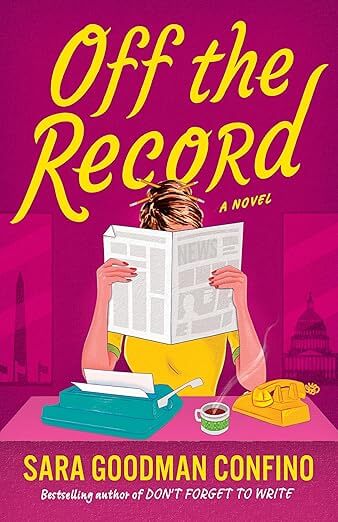 Off the Record follows Judy Greenberg, a recent college graduate (who got a bachelor’s degree, not the MRS degree that her mother hoped for) who is determined to become a journalist. But no one is going to hire her because she’s a woman. She agrees to a job in a newspaper typing pool as a stepping stone and takes a cryptic message for an editor—who tells her to drop it. With the help of a young male reporter (spoiler: love interest), she follows the lead and uncovers a Cuban spy plot. It’s half Jewish rom-com, half Cold War spy thriller, and a whole lot of fun along the way!
Please share your favorite line(s) or quote from this book:
Without giving anything away…
“Fields,” I said, suddenly deadly earnest. “Is there a Cuban woman?”
“I’d assume there are a lot of them or there would be no Cuban babies.”“Leonard,” my mother said, putting a hand on my father’s arm. “Give him your keys.”
My father looked at her like she had grown a second head. “Why?”
“They should take your car.”
“Why? He has a car. Doesn’t he?” He peered around my mother to look out the window.
“Yes, but did you see it? They should take yours.”
Fields and I exchanged another look. “Mom—he can hear you.”
“Well I’m sure he knows what his car looks like.”
Please share a few Fun facts about this book…
- So I actually came up with the idea on the Peloton—I was trying to think of an early 60s topic and Cody Rigsby mentioned Marilyn Monroe. And I was like huh… that’s interesting. Then I remembered that a random guy at a bar in DC had once told me that Kennedy sent people to that bar to pick up girls to bring back to the White House. That turned out to be a lie (that bar opened in 1971), but I talked to my friend’s husband who had brought us there and he said it was more likely to be Off the Record at the Hay-Adams if that happened. And an idea was born!
- Part of the inspiration also came from a neighbor of mine growing up, who we all thought was an accountant. When she retired, we learned she actually worked for the CIA. And this was the LAST person you’d expect to be a spy. But pretty much everyone who has lived in the DC area has a story like that, so it was a fun concept to play with.
- The funniest part of writing it, however, was the scene at Duke Zeibert’s restaurant. I wrote the scene where one of Judy’s coworkers asks if she knows Duke because they’re both Jewish. And she’s like uhhhh… no. The community isn’t THAT small. Then, of course, Duke knows her father and uncle. After I wrote it, I called my father, who grew up in the DC area, and asked if he had ever eaten there so I could mine his memories a bit. And he says to me, “No. But I went to junior high with his daughter!” Jewish geography is hilarious
What first attracts your Hero to the Heroine and vice versa?
Jack absolutely falls first for Judy and it’s largely because of her determination. She knows what she’s doing, and she’s not going to let anyone stand in her way—including him, and he actually respects that tremendously. Judy, on other hand, likes that Jack respects her and her abilities. Every other man she knows just wants a wife who will be a homemaker. Jack values what she does. And he genuinely wants to help her succeed.
Did any scene have you blushing, crying or laughing while writing it? And Why?
I laughed at every scene Judy’s grandmother was in because she absolutely stole the show. But ESPECIALLY the part where Judy’s mother is trying to set her up with a cantor—Sylvia, Judy’s grandmother, gets rid of him, and then when Judy is worried her mother will just invite him back, Sylvia warms up a piece of chocolate in her hands and smears it on the white living room sofa to make it look like the cantor had an upset stomach. He doesn’t get invited back.
The other scene that I cracked up while writing is when Jack comes to pick Judy up at her house—I won’t spoil anything, but it’s a FUN scene.
Readers should read this book….
because it’s got a little bit of everything. It’s a fun love story, but also an adventure. And a lot of it could have really happened!
What are you currently working on? What other releases do you have in the works?
I actually have TWO books in 2027!
The first is a contemporary romcom set at the Jersey Shore, called It’s a Shore Thing—in that one, a 32-year-old woman has one summer to try to turn a profit on her family’s shore house so they don’t sell it—all while trying to finish and sell her first book. She gets help from her brother’s childhood friend, who is now a super hot contractor (in more ways than one—this book has my first legit sex scene!)
The second book has a working title that I’m going to request we change, but it’s centered around the first US Beatles show in DC in February 1964. I’m writing that one now and loving it already!
Thanks for blogging at HJ!
Giveaway: A signed book, with an Off the Record reporter’s notebook and Off the Record bar coaster (US only)
To enter Giveaway, please share this post on your Socials and Leave a comment below to this Q: How far would you go for your dream job?
🎉 Giveaway Rules 🎉
✨ Must be 18 years or older to enter.
✨ MUST leave a comment answering the giveaway question.
✨ Bonus Entry:Share this post on your social media (Facebook, Twitter, Instagram)
and drop a comment below letting me know you've shared it.
✨ Winner(s) will be selected at random.
✨ No purchase necessary—just enter and cross your fingers!
✨ If you win, I'll need your full name and mailing address to send your prize.
This information will be shared with the author, publisher, or publicist solely for prize fulfillment purposes.
✨ Giveaway closes 3 days from the date this post is published.
Excerpt from Off the Record:
My family wasn’t religious. I set foot in synagogue exactly four times a year if no one had a baby, a bar mitzvah, or a wedding. Twice for Rosh Hashanah, twice for Yom Kippur. And we kept what we joked was called “Maryland kosher,” meaning we basically kept kosher in the house, but crabs were the exception. Because those were eaten off newspaper, not plates, and typically outdoors at a picnic table, they didn’t upset the balance.
At least that’s what we told ourselves.
But every Friday night, we all gathered at my parents’ house for Shabbat dinner. Me, my sister, her husband, their growing brood, occasionally Uncle Gil, and always my grandmother Sylvia, who lived with us. She came to America when she was five from some town in Russia whose name seemed to contain the entire alphabet.
It didn’t matter what plans I had—and that included when I was in college—my presence was expected. Demanded. Required. And no, attending Shabbat at Hillel on campus did not qualify as good enough.
So the first week of my employment was no different. Some of the girls from the office said they were going out for drinks and invited me to join them, but I had to explain that Friday nights were nonnegotiable. I doubted that would change even if I moved to New York—they would expect me on that train home every Friday afternoon.
“I get it,” Carol said. “If I miss church on Sunday, my parents will disown me.”
“Yeah, but you have a lot to confess to,” Gladys said.
“I’m not Catholic!”
“Maybe you should be—you could use a clean slate.”
We all laughed. But I still left promptly at five, watching as the girls walked in the opposite direction while I went to catch the bus home.
The job wasn’t all I had hoped for—typing all day was tedious and I longed to interview people and collect information, sifting through and slotting it into the inverted pyramid to make sure readers got the most important information first. It drove me crazy when an article buried the lead or put unimportant details too close to the top. But it wasn’t my place to fix these errors—and unlike with Fields, who wanted feedback, if another reporter traced an overhaul of their work to me, not Editorial, I’d wind up out on my behind pretty quickly. I did regret losing that single avenue to enjoying my work. Loath as I was to admit it, reworking Jack’s articles had been a highlight of my week.
But I maintained hope that it would lead to more. I couldn’t give that up. I had to believe things were going to change—even if not as quickly as I wanted them to—so that I could have a chance to achieve more than a secretarial job as a pit stop on the way to marriage. I wanted more than that so badly I could taste it. Yet it was still dangling out of reach, a couple of floors above my head.
I got home, called a quick hello, and ran upstairs to freshen up, change out of Betty’s dress before I got caught, and scrub the typewriter ink off my fingers. If I was smart, I told myself, I would start wearing my own dresses on Fridays, so I wouldn’t risk Betty spotting me in hers.
The house smelled of fresh challah, my mother’s brisket, and the onions that seasoned various potato dishes. There was no better scent than a Jewish household on a Friday night, and I hurried back downstairs, hungry, tired, and ready to fall into bed after dinner, where I was greeted with my alternative to success.
I stopped short at the sight of a man sitting next to my seat at the table, which had been rearranged to squeeze in the extra spot. I glanced at my mother, bustling around the dining room, placing dishes of food, and my sister, who was helping her, though she snaked a hand behind herself to rub her lower back frequently. My mother caught my eye and inclined her head toward my chair, telling me to sit. I obliged but wasn’t happy. As much as I didn’t want to be serving the food after a week of working, it was infinitely preferable to my family staring at me during an attempted fixup.
“Hello,” I said cautiously.
He looked over at me, and my heart sank. This was not some dashing stranger who would understand my desire to have a career before a family. He was at least ten years older than me, not much taller, heavyset, and balding. He wore glasses, behind which were a pair of mildly crossed brown eyes, over a nose that a girl would have had fixed by now. If I had children with this man, they would be doomed, even with the obligatory sweet sixteen nose job.
“Hello,” he said around a mouthful of my grandmother’s mock chopped liver.
And he talked with his mouth full. Nope. Absolutely not. I may have been twenty-two, unmarried, and employed—a trifecta of shandas—or shames—according to my family, but I did have standards.
“Judy, meet Gordon Levy. He’s a cantor.” My mother was brimming with pride.
“Shouldn’t a cantor know to wait until we say the motzi to eat?” I clapped a hand over my mouth. I hadn’t meant to say that out loud, and the consequences would be—
“Judith!” My mother was horrified. Uncle Gil’s lips were pursed in dissatisfaction though not surprise. Betty blinked heavily and shook her head. Her husband, Reuben, slapped a hand to his forehead. Only my father and grandmother looked amused, though my father quickly replaced his almost smile with a stern look after a glance at my mother.
“Sorry,” I said. “It’s been a long week. I’m overtired. I shouldn’t have—”
“You’re not wrong,” Cantor Levy said amiably. “But I find that deference to elders is more important than blessings, and your grandmother insisted I try her chopped liver.”
“Mock,” I said. “It’s made of lentils.”
“Don’t give away family recipes unless you’re planning to marry him,” my grandmother said. She reached across the table and put a hand on mine. “I don’t think we’re worried about that tonight though.”
“Sylvia!” My mother said.
But I was bolstered by the support.
“Your parents tell me you started a new job this week,” Cantor Levy said. “At a newspaper?”
I nodded. “The Washington Digest.”
“Oh,” he said noncommittally. “I subscribe to The Washington Post.”
So did we, but I didn’t like the way he was shrugging off my new job. Never mind that I didn’t even read The Digest.
“We subscribe to both,” my father said.
“We do?” I asked.
He winked at me. “As of this morning. Delivery starts Monday.”
My heart swelled in my chest. As mad as he should have been that I didn’t bother with Uncle Gil’s interview, he was proud of me.
My mother pulled a matchbook from the credenza, and the table quieted as she lit the candles and then covered her eyes to say the traditional Shabbat prayers. We all said, “Shabbat shalom,” and then she asked if Cantor Levy would like to lead us in the motzi—the prayer said before eating.
Not that we literally ever said it except on Friday nights or as part of the Passover seder. But Cantor Levy opened his mouth, and his clear tenor rose, far too loud for our dining room, in a voice that was better suited to shul than a family dining table. I wondered, as he drew the syllables out longer than any human needed to, who was singing to his congregation tonight.
I also wondered how such an ugly man could have such a lovely voice, but I supposed it balanced out.
Dinner was easy enough—largely because I was too exhausted from the week to do much to put this man off. But when the meal was finished, and I stood up to help my mother clear the table, she stopped me. “You should take Cantor Levy to the living room,” she said. “Get to know him a little.”
The only times I had been allowed to sit on the white sofas in our formal living room were when I was in trouble—big trouble—or when my parents were telling me someone had died. Betty’s kids weren’t allowed to play on the furniture in there. And I hadn’t graduated to sitting unless I had crashed the car and needed a stern lecture. Or—I glanced at my grandmother—no, she was definitely still breathing. “Mom, I’m awfully tired and—”
“Be polite to our guest,” she hissed at me.
I looked to my dad for help, but he pretended not to notice. He would subscribe to a newspaper for me, but stand up to my mother?
That was uncharted territory full of unknown perils.
I was on my own.
“Cantor Levy, would you like to join me in the living room?”
“I’d be delighted,” he said, rising and offering me his arm. I pretended not to notice. It was all of a ten-foot journey after all. Though I did note that I was a smidge taller than him in my three-inch heels. For me, that was quite the feat.
“My parents must like you,” I said wryly as he sat on the sofa. I opted for an armchair. The white sofas gave me the heebie-jeebies after so many years of lectures on them.
“Why’s that?”
“I’m not allowed in this room.”
He chuckled. “How old are you anyway? Nineteen?”
My mouth turned down. My mother had probably knocked a couple of years off my age to lure him here. I was bordering on spinster territory according to her after all.
“Twenty-two. I graduated from the University of Maryland last month.”
“Really?”
“Is that so surprising?”
“To still be unmarried, well—yes.”
Here it was. “Cantor Levy—”
“Gordon,” he said amiably. “We’re not in shul tonight.”
“Yes, well, you should know that I have no interest in getting married anytime soon.”
He looked confused.
“I want to make a name for myself in journalism.”
“Why?” The question was said without disdain but with genuine incredulity.
“Because I love it,” I said. “Why did you become a cantor?”
“Well”—he puffed out his chest, and the resemblance to a bespectacled toad became uncanny—“you’ve heard me sing.”
“Yes, well . . . that’s how I write. Like how you sing.”
“That’s hardly a realistic comparison.”
I wondered what would happen if I yelled for my father and said this man had put his hand up my skirt. He’d show him the door— unless my mother insisted that was grounds for marriage. Not worth the risk. Though it had worked when I was seventeen and Uncle Gil had come to dinner with a girlfriend and her creepy son.
But a cantor was a different story altogether.
I was saved by my grandmother wandering into the room and plopping down on the other, unoccupied, sofa. “In my day, an unmarried man and woman needed a chaperone,” she said. Then she belched, closed her eyes, and began to snore.
Loudly.
Too loudly.
In fact, every time Cantor Levy started to speak, the snores got louder, to the point where it was a futile endeavor and he eventually rose to leave. My grandmother opened one eye and grinned at me before resuming her fake snores.
“I suppose I should be going,” he said, standing. “Shabbat services in the morning and all. You should come—Temple Beth Shalom.” Beth Shalom was an Orthodox congregation a couple of miles away. Men didn’t sit with women, and services there could go five or six hours easy. I would absolutely not be doing that.
“Thank you so much for the offer, but I’m afraid I am otherwise engaged tomorrow morning.”
His brows came together. “On Shabbat?”
“Yes. Orthodox life just isn’t for me.”
He opened his mouth to argue, and my grandmother let out a little sleep shriek that I was sure was actually a disguised laugh.
“I see. Yes, well, if you have plans on Shabbat, I suppose this isn’t going to work anyway.”
“No, Cantor Levy, it is not. Good night.”
“Tell your parents I said thank you for the lovely meal.”
I told him I would, but I remained in the living room while he left. The second the front door closed, my grandmother’s eyes sprang open. I plopped down in the spot next to her on the forbidden sofa and leaned my head on her shoulder. “Thank you.”
She put an arm around me. “You’ll marry a man who behaves—and looks—like that over my dead body.”
“Grandma!”
“What?”
“Don’t say that in here! I’m only allowed on these sofas when I’m in trouble or my parents need to tell me someone died.”
She reached up and pinched my cheek. “It’ll take more than a white sofa to kill me. Though your mother might come after you for rejecting a cantor.” She pulled a small wrapped chocolate from her pocket, rubbed it between her hands like she was trying to start a fire, and then opened it. With a hand on me to steady her, she stood up, went to the other sofa, and smeared the now-melted chocolate on the seat.
“What are you doing?” I asked, panicked. I was going to get blamed for this. I knew it.
“Bubbelah, do you think this is my first time dealing with your mother? We’re going to tell her he stained her good sofa. And I doubt she’ll smell to see that it’s chocolate. He won’t be back.”
I laughed merrily. The rest of my family may have thought I was pure trouble, but if anyone questioned where I came from, they needed to look no further than my grandmother.
“Now,” she said. “Tell me everything about this job. Do you know I had a job when I first came here? I worked as a soda girl, and I loved every minute of it.” I did know that, but I let her reminisce before I told her all about my adventures from the week. Though I did leave out Patricia’s birth control advice. We were still on the white sofas after all.
Excerpt. © Reprinted by permission. All rights reserved.
Book Info:
An aspiring newspaper reporter comes across a mystery that threatens to turn the Cold War hot in a funny, thrilling, and strictly undercover romantic comedy by the bestselling author of Don’t Forget to Write.
In 1962, opportunities are typically few for nice Jewish girls clacking away at ninety words per minute in a newspaper typing pool. Except Judy Greenberg isn’t typical. An aspiring reporter in DC, she’s aiming for journalistic greatness―not finding a husband. Just don’t tell her mother.
Then one day she answers her boss’s private line. The message is curiously cryptic. It’s also delivered in a Russian accent. Judy is certain she has stumbled upon a scoop. Charming reporter Jack Fields isn’t one to dismiss Judy’s instincts. Perfect. A seasoned ally she can trust, not to mention pass off as a pretend boyfriend around her relieved parents. Together, they’re following the leads―from a clandestine hotel bar to the dressing room of a slinky Cuban nightclub singer to an exhilarating underground of secrets and spies stretching from Moscow to Havana to Texas.
Now Judy must choose between the safe life expected of her or one hell of a dangerous story that could make her career. She might even fall in love for real. If her ambitions don’t get her killed.
Book Links: Amazon | B&N | iTunes |
Meet the Author:
Sara Goodman Confino is the bestselling author of six novels: Don’t Forget to Write, Good Grief, Behind Every Good Man, She’s Up to No Good, For the Love of Friends, and the upcoming Off the Record. After spending more years than she’s willing to publicly admit teaching high school English and journalism, she is currently writing full time and trying to make a living off of the crazy stories in her head. She lives in Montgomery County, Maryland with her husband, two sons, and two miniature schnauzers. When she’s not writing or frantically parenting, she can be found on the Peloton, at the beach, or at a Bruce Springsteen concert, sometimes even dancing onstage.
Website | Facebook | Instagram | GoodReads |
Audrey Stewart
In my younger days, I would’ve traveled anywhere in the world for my dream job. But not now. The world is in such a state that I wouldn’t feel safe. I also would never go up north. I am a southern girl in Charleston, SC.
Audrey Stewart
I shared on (X) Twitter: https://x.com/AudreyS23511436/status/2064327762257543455?
Audrey Stewart
I shared on Facebook: https://www.facebook.com/audrey.stewart.140/posts/pfbid02E6aBVyFNYdo242YdumDYSzxyKU5xa5QNRZbBuqTbwkNbUcwLVMgUi8MvCN1UhJdKl
Audrey Stewart
I shared on Pinterest: https://www.pinterest.com/pin/535506211965357793/
Latifa Morrisette
I would go pretty far for my dream job.
Nancy Jones
I would the distance. Shared on facebook and x.
Amy R
How far would you go for your dream job? I would need a lot of information before I could make any decisions.
bn100
not sure
cherierj
I wouldn’t do anything illegal.
Diana Hardt
I’m not sure.
janinecatmom
I would go pretty far for a dream job. I shared on X.
https://x.com/JanineRowe7/status/2064656631468601485
Glenda M
I did move to another state for what was my dream job at the time.
Glenda M
Shared on X
Kim
I’m not sure how far I would go. I know I wouldn’t do anything to hurt someone else and anything that I would regret doing.
Kim
Shared on Facebook
Patricia B.
I would move to the other side of the world.. I already did that and it was the best thing I could have done.
Latesha B.
Not sure because I don’t know what my dream job is any more.
Patricia B.
Shared on Facebook, Pinterest, Instagram. (Twitter kicked me off).