
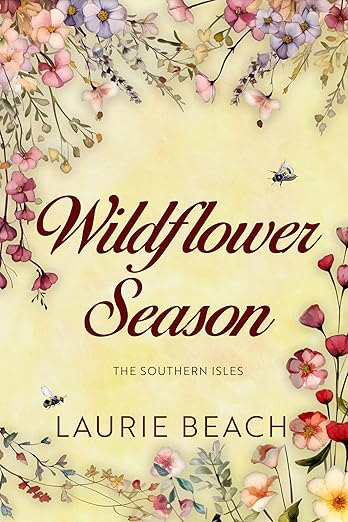
Today, HJ is pleased to share with you Laurie Beach’s new release: Wildflower Season

Tulip ‘Tootie’ Boone is as wild and free as the wildflowers growing near her grounded houseboat.
 She’s also completely lost. All she wants is a simple life, a job, and strong family roots. It feels like an impossible thing to create alone.
When she meets a young man in an old pirate cave, their instant connection is more valuable than gold. But can his ongoing interest withstand his movie star status, his bratty teenage sister, and the whims of Mother Nature?
After Tootie uncovers shocking family truths that survived for generations in an abandoned Charleston cemetery, new realities hold the power to change her forever. One of those revelations may literally hold the key to her future, but what does she want? And who will stand with her?
Wildflower Season is a warmly atmospheric novel filled with Southern quirks and love in all its forms. It’s an immersive dive into family dynamics, big dreams, and unlikely pairs. As layered as a gooey Southern casserole, this tale will warm you from the inside out. Fans of Outer Banks and Notting Hill will love this lyrically gorgeous story.
Enjoy an exclusive excerpt from Wildflower Season
Chapter One
There was no good reason why a boy from elementary school would be remembered so distinctly, except for the fact that Tulip “Tootie” Boone married him right there underneath the thick-branched canopy of an angel oak tree during second grade recess. They even sealed it with a kiss. The entire class saw it all—the vows, the hand-holding, and the tight-puckered smooch. Just a few months later, Tootie’s three-foot-five, red-haired practice husband—the one who ran the fastest and drew a great rendition of a horse—was gone. Never to be heard from again. It was strange how some memories slipped away like water down a drain and others stuck like boiled rice to silk. For Tootie, that oak tree wedding had a permanent home in her memory next to Dr. Pepper floats and cat-themed socks.Even as a full-fledged adult that memory still poked into her consciousness occasionally. Lately, it came in the evenings when she sat alone in a beach chair on the back end of her uncle’s grounded houseboat—the one he’d gifted to her when she graduated college. They’d moved it to a flat piece of land and set it on cinder blocks like it was an honest-to-goodness mobile home rather than an old unseaworthy boat. The land didn’t belong to her—she paid a small amount of rent to her big sister, Jessa, who owned all two acres and a small bungalow smack in the middle. Jessa had given Tootie a spot by the marsh just a few yards from a rickety wooden dock that, as long as it’d been standing, had rusty crab traps sitting at the end of it. No one used them for crabbing anymore, instead they served as a place to sit, place a soda, or a plate of food. The old dock always groaned and squeaked as the tides rose and fell or when the wind blew especially hard. That Thursday afternoon, the dock was screaming.
The forecast called for a bomb cyclone. The term was alternately horrifying and exhilarating. She’d been waiting for it to hit all day—it was probably going to be the last big storm of the cold season. Signs of spring were already everywhere—the dogwoods were leafing out, robins tweeted loudly, little frogs called peepers made the evenings a chorus of chirping, while green shoots of spartina grass popped up in the salt marshes, and azaleas and redbuds went all out for their debut moment. Even the pine trees joined in the hullaballoo by covering everything in a yellow dusting of pollen.
Tootie considered running to her mother’s warm, cat-filled brick house to ride out the storm. Even her sister’s little wooden bungalow would be better than a broken-down boat held up by concrete blocks. But the independent, adventurous part of her wanted to be outside in the middle of it. Maybe she would walk to the old smuggler’s cave where the lightning couldn’t reach her. She could sit inside the rocks and feel the power of the storm in the air, the earth, and the sea. Or maybe she would stay close to home and lie down on the end of the dock, letting the rain soak her hair and her clothes—all the way down to her skin and into her spirit. Cave or dock? There was no rain yet, but the skies gave their blackened warning as they could always be counted on to do.
She needed something extreme—a shock to her system to help dislodge her jammed-up thoughts and finally make clear what she was supposed to be doing with her life. She had degrees in art and economics, but the thought of sitting at a desk, or worse, being paid to create bespoke paintings of people’s pets, or their new homes, or their favorite childhood stuffie, felt hellish. The pressure was on to find a job. More than that, really, she needed to find a purpose in life, a path that suited her. Four years of college were supposed to lead her straight to it, but instead, she was back home on Goose Island flopping around like a strand-feeding dolphin.
The dock let out a cracking sound so loud and ominous that Tootie’s choice was made in an instant. Falling into the marsh shallows with the crabs, clams, pluff mud, and thick grasses didn’t sound like fun at all. The smuggler’s cave, though. That could be an adventure.
It was a long way to the cave—she had to go to Charleston first and then cross two bridges. The rain began with large, slow droplets. They weren’t a bother. She’d just replaced the windshield wipers on her old white pickup truck. If the winds and rain grew to be too much, she’d just park and go inside somewhere.
The trip took longer than usual, and it was hard to hear the radio over the sound of the storm, but all in all, it wasn’t bad. No one else was out. The boats in the harbor were moored, and the beaches were empty. She looked for signs of life through the rain-sheeted windows and saw none. That was a relief. She loved having places to herself.
As much as she considered never returning home to Goose Island once she got to college two hours away in Columbia, there was something powerful about the sea islands—something that spoke to her soul. She’d always felt a kinship with the inhabitants who came before—the Gullah Geechee people, missionaries, even the reviled pirates who considered Charleston the northernmost point of the Caribbean and spent their gold and silver in the city while using the coves and islands for shelter. She thought about the famous pirate, Blackbeard, who used to keep slow-burning cannon fuses lit in his beard to scare and intimidate people. And the female pirate, Anne Bonny, who dressed as a man during battles.
Tootie had always been tickled by the tales of Anne Bonny. No one knew if she’d been killed, or if she lived out her life as a regular woman in Charleston. It was fun to think about a woman going from a life of attacking and pillaging, to dresses and tea parties in the garden. Tootie figured her own personality was somewhere in between her sweet older sister, Jessa, and that fearless fighter Anne Bonny. Tootie was no criminal, but she couldn’t stand to sit around acting nice and looking pretty either.
The smuggler’s cave was not a tourist destination. Only locals knew about it, and they meant to keep it that way. She found a spot to park on the side of the road near a dune. It was about a two-mile walk down the beach. There were a few old beach houses left in the area that had long since been abandoned. Both the road and beach leading to them were blocked and permanently closed. The Lowcountry was called “low” for a reason, and the mighty Atlantic was rising up to prove it. No beach house built too close to its waters could withstand the force. Tootie paid no attention to the bright orange traffic barrels and construction barricades. She just walked into the surf to get around them.
The rain was falling harder now, and the wind, which had been gently blowing in one direction, became swirly and increasingly angry. Tootie’s long brown hair whipped into her eyes and mouth, making her wish she’d brought a hair band. When she found a thin, bleached-out piece of driftwood, she spun her hair into a bun and used the stick like a pencil to hold the hair in place. That worked for the majority of it, but brown tendrils still poked at her eyes and tickled her cheeks. She had to make it past the final doomed house in order to get to the cave, so she picked up her pace. A smile that invited droplets of water into her mouth was unavoidable as she broke into a jog. It was just what she wanted—to be out in the world feeling like she was part of the maelstrom.
The closer she got to the tall, empty wooden house, the more she heard the same kind of groans and creaks that she’d heard from the old dock back home. The tide was rising and licking at the skinny piers that held it up. They looked like they couldn’t hold a vine of beans, yet the two stories of square-walled house on top of them somehow remained upright. She watched the house as she moved closer, with a plan to run past it, but stopped in awe as the structure rocked slightly backward and then thrust violently forward. It exploded onto the beach and into the sea. That last wave was the proverbial straw and the camel’s back had been permanently broken. Tootie didn’t move. The house had fought valiantly for years, but in the end, the ocean bumped it, and with the tiniest nudge, it fell. She was shocked at her luck—that she’d been the lone witness to something so important. It was the end of an era for a house and for whoever once lived there. The feeling was one of reverence, like she should pray or sing or say something profound to mark the loss. She sank to her knees and sat cross-legged on the sand as she watched each wave take bits of wood and carry them out to sea.
The view of the rest of the beach was now unobstructed without the house there. She could see the odd little bluff she was headed to in the distance. It was a rare topographical shift in the area, a spot that suddenly switched from beach to protruding rock like there’d been a mistake, or at least an earthquake a gazillion years ago. She wanted to properly mark the passing of the old, tortured home, to take her time and savor every bit of passion and destruction the storm whipped up, but she also had to get to the cave and then back to her car before dark set in and the rain got colder. Already, she was feeling the chill. But in that moment, she was perfectly content to sit in the wind, soak in the rain, and listen to the sounds of the ocean swallowing a house.
A movement from the dune to her left caught her eye. At first, she thought it was a bobcat, but a flash of dark blue dissuaded her from that. It had to be a person. Whoever it was, was now on the far side of the dune, so she couldn’t see them anymore. Had they purposefully been there to watch the house die? Did they know there was going to be a death today? She was suddenly uncomfortably aware that her oversized T-shirt was sucked against her body as tightly as her leggings.
To get to the cave meant she would have to jog in the direction of that person. It’d probably be safer to jog in the direction of a bobcat. Unless she went back to her truck, there was no way to avoid a confrontation. Where had the person come from? She hadn’t seen any other vehicles for several miles. The half of the island she’d walked to was overrun with palmettos, live oaks, sticker bushes, and hard-to-move-in wilderness. She wished the rain wasn’t impeding her ability to see long distances. They might as well just show themselves. Her curiosity was testing her patience.
Screw it. She jogged behind the fallen house with her senses on high alert and jumped when a figure appeared in front of her. Like an apparition, he stepped slowly from behind the dune, purposefully making himself known. It was a man. She couldn’t tell his age, but he was average height, and he wore khaki shorts and a blue shirt. His dark hair was soaked, and he kept slicking it back with his right hand. She was well aware that there were likely no other humans within earshot, so she held her phone like a weapon as he walked toward her. Maybe it was because he walked like an athlete, or a college boy, but she wasn’t frightened. He didn’t walk like a serial killer. Because, you know, all serial killers walk the same.
Excerpt. ©Laurie Beach. Posted by arrangement with the publisher. All rights reserved.
Giveaway: Winner will receieve one ebook copy of WILDFLOWER SEASON plus one additional ebook of the winner’s choice from Tule Publishing.
To enter Giveaway: Please complete the Rafflecopter form and post a comment to this Q: What did you think of the excerpt spotlighted here? Leave a comment with your thoughts on the book…
Meet the Author:
Laurie Beach is a former news reporter, advertising producer, and political press secretary who, after raising children, is parlaying her love of reading and writing into a career as an author. She is a sucker for elderly people, furry animals, and all things chocolate. Having grown up in Alabama, she loves novels set in the South. Laurie now lives in Colorado with her husband, herds of elk, and the occasional bear.
Buy: https://tulepublishing.com/books/wildflower-season/#order
Janine Rowe
I loved this book and the entire series.
hartfiction
I love a Southern setting!
Kathleen O
I really liked it!
bn100
was nice
Kingsumo not working for me
Colleen C.
I want to read more…
Mary C
Looking forward to reading more.
Bonnie
What a wonderful book! Great excerpt. I’d love to read more.
psu1493
The excerpt was good and I had to laugh at the line that all serial killers walk the same.
Dianne Casey
Sounds like a book I would really enjoy reading.
Patricia B.
I loved the excerpt. It lets us know just who Tulip “Tootie” is, and where she is in her life. She is very relatable for me. Though not on the coast, I have walked in my share of rain storms. The description of the demise of the beach house is very well done. I love that it leaves us hanging. Great hook.
Shannon Capelle
This sounds like a wonderful book
Nan
Laurie’s voice is so wonderful–can’t wait to read this one!
Amy R
What did you think of the excerpt spotlighted here? Sounds good