Today it is my pleasure to Welcome author Eliza Knight to HJ!


Hi Eliza and welcome to HJ! We’re so excited to chat with you about your new release, Lost in the Summer of ’69!
Please summarize the book for the readers here:
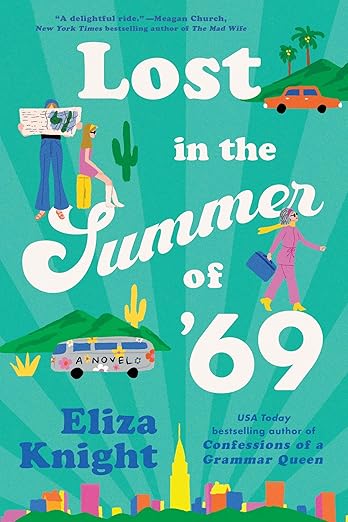 Lost in the Summer of ’69 is a multi-generational story about three women, Eleanor, Leanne and Nora, who embark on an unforgettable summer adventure road trip traveling to concerts from coast to coast. After discovering she has early dementia, Eleanor decides to relive her youth as a musician. Leanne, facing an empty-nest and unsure of who she is, embraces self-discovery. Nora, about to matriculate as one of the first female students at Yale, wants to embrace her own autonomy. Full of nostalgia, the story is a love letter to of summertime shenanigans, memories, music of the sixties, mother and daughter relationships, and savoring the encore.
Please share your favorite line(s) or quote from this book:
All around her, people danced. Colorful clothes swirling, fringe
swaying, sweat glistening on open, joyful faces. Didn’t matter who you
were or where you came from.
No one was thinking about war. Or dinner. Or making sure the
laundry was folded just right.
There were only a million hands in the air.
Swaying.
Beating like a single heart from one soul.
Peace and music, she thought. This is what it means to be alive.
Please share a few Fun facts about this book…
This was such a fun book to write. I had a blast researching all of the concerts that happened that epic summer of 1969, including Woodstock. Fun fact, they thought they’d only have about 50,000 attendees, but they ended up with 10x that much and ran out of food! People were making and sharing peanut butter and jelly sandwiches. I listened to songs from the concerts every day before I started writing, and I created a playlist on Spotify, titled Lost in the Summer of ’69, that you can listen to! Another part of the research process I had fun with was that during their road trop, Leanne and her teenage daughter read books together. The Godfather and The Love Machine. I had fun reading those books right along with them!
What first attracts your Hero to the Heroine and vice versa?
Each character in the book has a love interest, but the most active one I would say is Nora, and an up-and-coming journalist named Joe. I think she’s attracted to his love of the written word, his quirkiness, and the way he flirts with her by actually paying attention to what she says.
Did any scene have you blushing, crying or laughing while writing it? And Why?
YES! So, if you haven’t read The Godfather or The Love Machine, first off there is a scene in The Godfather about one of the male character’s giant you know what… And The Love Machine is a super racy novel with a cover that makes her blush (see excerpt below!). I was getting secondhand embarrassment writing the conversations between mother and daughter as I experienced BOTH of their emotions. It was seriously so fun to write, and I hope it sparks conversations with readers!
Nestled among tissues, a compact mirror, a tube of lipstick, and a roll of Certs
peppermints, was a hardback with a cracked spine. Drawing it out, Nora inspected the
cover like it might singe her fingers. Holy crap.
There was a close-up photograph of a man’s hand clasping a woman’s, the image
tight and intimate. Something about how his fingers curled around hers—possessive,
urgent—made Nora’s face go hot.There was no mistaking the intent.
It wasn’t just a handhold.
It was sex.
Angsty, glossy, unapologetic sex.
Her eyes drifted to the ring on the man’s finger—bold, gold, and centered with a
strange symbol she recognized immediately from her world history unit: the ankh, the
ancient Egyptian sign for life. Eternal life. Fertility. Vitality.On the cover model’s hand, though, it didn’t feel sacred.
It felt carnal.
Like a promise.
At the top of the cover, Jacqueline Susann was stamped in bold, black, uppercase
letters—like the author was daring you to judge her. Just below the photograph, in a
sultry serif font, sat the title: The Love Machine.
Readers should read this book….
If they love road trips, mother-daughter stories, stories about self-discovery, love, music and historical fiction, you don’t want to miss this nostalgic tale about three incredible women on an epic journey they won’t ever forget!
What are you currently working on? What other releases do you have in the works?
I’m on quite an extensive book tour this summer! But in the meantime, I’m working on a new women’s fiction novel that takes place in Greece. I’m VERY excited about it, and can’t wait to share more soon!
Thanks for blogging at HJ!
Giveaway: A signed copy of LOST IN THE SUMMER OF ‘69 with a custom-made sticker!
To enter Giveaway, please share this post on your Socials and Leave a comment below to this Q: If you could go back in time to the 60’s what would be a moment you’d want to live in?.
🎉 Giveaway Rules 🎉
✨ Must be 18 years or older to enter.
✨ MUST leave a comment answering the giveaway question.
✨ Bonus Entry:Share this post on your social media (Facebook, Twitter, Instagram)
and drop a comment below letting me know you've shared it.
✨ Winner(s) will be selected at random.
✨ No purchase necessary—just enter and cross your fingers!
✨ If you win, I'll need your full name and mailing address to send your prize.
This information will be shared with the author, publisher, or publicist solely for prize fulfillment purposes.
✨ Giveaway closes 3 days from the date this post is published.
Excerpt from Lost in the Summer of ’69:
Stomp
the Intro
SUMMER 2019
NORA PERCHED ON A WICKER LOVE SEAT ON THE BACK
patio of her daughter’s house, steam curling from her cup into the early
spring air. The garden was quiet—until
it wasn’t. Nora tucked a silver-nearly-
white
strand of hair behind her ear. Inside, there appeared to be
an argument brewing between Anne and her teenage daughter, Ellie.
While it was probably inappropriate to smile, Nora couldn’t help
doing so. At Ellie’s age, she and her own mother had had a few knock-down,
drag-out
fights over stupid things like boys, length of skirts, and
music. And later, she’d listened to Anne stomp off just the same. Time
softened the edges, but it never dulled the echo.
She leaned toward the window, snooping, because at her age, a
little drama always provided a bit of a thrill.
“Why not?” Punctuating the ever-present
why was the stomp of a foot.
2 ELIZA KNIGHT
Nora tsked. Didn’t Ellie know by now—at
seventeen—that
stomping
one’s foot was simply silly? And with Anne, a prosecutor for the
state, that it would get her nowhere?
Anne’s words were muffled through the window, no doubt spoken
in the calm, cool, collected manner she’d used since she was two and
made a very sound argument to her mother about why she should be
allowed to stay up later than her usual bedtime. And it wasn’t because
she wasn’t tired; it was because if she’d gone to bed on time, she wouldn’t
have been able to warn the cow not to jump over the moon—he’d
break his legs on the fall down to earth.
Nora had agreed and let her stay up an extra ten minutes.
The argument grew louder, their voices trailing closer, and then
Anne was out on the back porch, arms crossed over her slim chest,
tapping her foot in impatience, and Ellie stood beside her looking very
much like a younger, identical version. Their raven-colored
hair was
reminiscent of Nora’s beloved late husband.
“My, what have I done to warrant the wrath of my two favorites?”
Nora worked hard to hide her smile.
“She wants to go to that Woodstock revival concert with her
friends—camping
and all! Mother, please tell Ellie she can’t go.” Anne
rolled her eyes as if the idea was offensive.
“It’s not even that big of a deal!” Ellie’s voice cracked. “Everyone
else’s parents said yes.”
Nora cocked her head, staring at Anne. Had her daughter really
forgotten about Nora’s epic summer adventure in the summer of ’69
when she’d gone to Woodstock herself? From the confused look on her
face, apparently, she had. “No.”
“See,” Anne said, gesturing toward Nora. “Your grandmother
said no.”
Nora chuckled. “Oh, Anne, I meant no I won’t tell her she can’t go.”
Anne’s mouth fell open. Nora was certain to get a lecture later
about allowing Anne to parent on her own, but then she’d remind
Anne—again—
that
inviting Nora into the debate came with consequences.
Not every argument needed a witness.
“Mother!” Anne’s voice held a warning edge.
“I’ll take her,” Nora said with a firm nod, eager to enjoy the evergreen
sounds of rock and roll, to relive that amazing summer that had
changed her life.
Anne’s eyes practically bulged. “You can’t take her to Woodstock;
that’s crazy. Don’t you remember what happened in 1999, the last time
they tried to revive that festival?”
Nora laughed a little louder, spilling droplets of tea until Anne
took her cup and set it on the cedar table. Woodstock 1999 had been
an utter disaster, that much was true. But maybe this time around,
the organizers had taken a few pointers from Lilith Fair in the ’90s,
which had been all about hope and comradery, well, and female
empowerment. Nora and Anne had gone to the Lilith Fair show at the
Jones Beach Amphitheater in celebration of Anne’s recent law school
graduation, and Nora still had a picture of them, smiling with Sarah
McLachlan singing onstage in the background, taped to her refrigerator
twenty years later. A snapshot reminder of who they were.
“What is so funny?” Anne demanded.
“Oh, Anne, my darling girl, have you forgotten what I told you
about your great-grandmother?”
Anne narrowed her eyes, and Nora could practically see her rolling
through the files she kept alphabetized and in chronological order in
the coils of her brain.
“Ellie,” Nora said, patting the seat beside her. “Let me tell you a
story about my grandmother, and how she got lost in the summer of
sixty-nine.
That summer changed everything for me. And maybe it will
for you too.”Part One — California Dreaming SUMMER 1969
ELEANOR BELL STRICKLAND HAD ALWAYS BELIEVED IN
omens. Signs. Little winks from the universe. And tonight, sitting
alone in her dimly lit living room, she couldn’t help but wonder if
turning sixty-nine
in the year 1969 was some kind of cosmic joke. A
cruel, poetic symmetry.
Her fingers sank into the royal-purple
velvet of the couch, the
fabric rich and smooth beneath her touch. A jazz record spun on the
record player in the corner, its low, scratchy hum curling into the air
like cigarette smoke. Overhead, the chandelier she’d found at a flea
market decades ago cast jagged shadows against the walls, flickering
like ghosts of old laughter, old arguments, old love.
On the mantel, next to the portrait of herself in her twenties—hair
swept up, eyes burning with the certainty of youth—was
the photograph
of her wedding day. A black-and-
white
relic of a life that had
once been brimming, roaring, unstoppable. She stood and brought the
picture back to the couch, tracing the edge of the frame with one trembling
finger. If only he were here. If only she could turn her head and
see him standing in the doorway, smirking at her dramatic sentimental
streak the way he always had.
But the room was quiet. Too quiet. And for the first time in her life,
Eleanor felt something slipping—something
she had spent years clinging
to. The fierce, electric hum of life that had always run through her
veins. Ebbing now, just slightly, just enough to make her wonder…
Was this what it felt like to fade?
Sixty-nine
in 1969. Her golden birthday. That was supposed to
mean something—supposed
to be special. She and Henry had always
talked about doing something big this year, something grand. A trip
back to Malibu, where they’d spent their honeymoon tangled in salt air
and endless, impossible love. Or maybe New Orleans, where the jazz
clubs pulsed like a second heartbeat, where she could finally dance in a
place that made music feel like magic.
But fate, as always, had its own sense of humor. And not the kind
that made you laugh.
Henry was gone.
One minute he was there, humming some off-key
tune while shaving,
teasing her about a gray hair she absolutely did not have. The
next—just…
gone. Vanished into the abyss, leaving her stranded in a
life that suddenly felt too quiet too still.
Age was a cruel joke. Death was a bully. It snatched, it sneered. It
took what it wanted and left you holding nothing but a hollowed-out
heart and a collection of what-ifs.
And now, on this golden day, she was left sitting here, staring at
the ghost of a life they’d planned. Wondering how, exactly, she was
supposed to celebrate when half of her had already been buried.
Eleanor forgot why she’d sunk so heavily onto the worn velvet of
her purple couch, why a slow, creeping melancholy had wrapped itself
around her shoulders like a too-familiar
shawl. But then her gaze fell
again to the slip of paper trembling in her lap, the inked scrawl of her
doctor’s handwriting etched sharp and final. The pamphlet she held
that started a ticking time bomb to the end. And the mourning of what
was written there came back all over again.
Dementia. Early signs.
The words blurred at the edges, but their meaning stayed razor clear.
She exhaled—long,
slow—and
let her gaze drift beyond the paper,
toward the taxidermy peacock perched on the painted brick hearth.
Its iridescent feathers shimmered dully in the afternoon light, glass
eyes staring back with a secret only she knew. Henry had never asked
about it, and she’d never offered the truth: that the peacock was a gift
from a lover, a young man with calloused fingers and a fedora tilted
on his head, a lifetime ago when her days were stitched with electric
possibility.
Back when she still believed she could set the world on fire.
She had wanted to be a star once. Could play the drums, strum a
guitar and a banjo—but
her real instrument had always been her voice.
Sweet, clear, a little wild around the edges. That’s what they used to say.
That’s what he used to say. Eleanor Bell, with a voice that rang like a bell.
She’d been a musician ahead of her time, chasing rhythms and riffs
the world wasn’t ready to hear in the 1920s.
Her fingers, still elegant despite the years, released the papers, letting
them fall to the floor like an afterthought. She stood, feet aching
from the heels she’d kicked off, but back straight, and crossed to the
record player. Gently, deliberately, she lifted the record from its spindle,
set it aside, and replaced it with something with a little more pulse.
Jimi Hendrix.
As the first notes of “Purple Haze” crackled to life, the chords
curled around her like smoke. A faint smile came to her lips. This
room, this purple couch—it
had all been shaped by the echoes of a
song, by the girl she used to be.
That girl wasn’t entirely gone yet.
With no one here to watch, Eleanor let herself be that girl again.
Fingers strumming invisible chords in the air, she twirled through her
living room, legs kicking, hips swaying, her body bending and flowing
as if she were one more instrument in the band. The music surged
through her, wild and free, and she moved like she’d never stopped, like
the aches and pains of age didn’t exist.
Certainly not how anyone imagined a grandmother should
dance—not
her daughter, not her granddaughter, and definitely not
the friends she swapped casserole recipes and polite conversation with.
But they’d never known her secret.
The secret she’d tucked away for the past four decades, folded
between grocery lists, laundry, and dirty diapers.
That Eleanor Bell, if the world had let her shine, would have been
wild and free—a
musician with an unforgettable voice, a wild style and
a long list of lovers. Someone who stayed on the stage and evolved as
the music did. Maybe even now, she would’ve been the greatest damn
rocker of all time.
Close behind the bully death was time, and time had stolen so
much from her.
She spun faster, her laughter caught in her throat, feet skimming
across the floor like those of a woman half her age. She let herself
believe she had no cares, no doctor’s words sitting heavy on her chest,
no shadow creeping in to steal the edges of her mind.
But the fact lingered there anyway. Just out of reach. Soon, maybe
tomorrow, maybe years from now, her memories would begin to slip
like a broken record. Memories of her husband’s hand in hers. Her
daughter’s first cry. The warm weight of her granddaughter curled
beside her on Sunday mornings.
And perhaps worst of all—the
flashbulb moments she’d hoarded
for herself, the ones she replayed when no one was watching. Bright
lights, sticky bar stages, the roar of a crowd. The nights before she’d
been a mother, a wife. When she had been the Bell of Wartime Music.
Sought after, cheered for.
She feared the loss of those memories, of being on the road, a
young singer, a budding star. Moments she’d cherished over the last
decades raising a family. Moments she’d relished in the night when
no one was paying attention or when she was knee-deep
in laundry or
dirty diapers. Those memories had kept her alive and kept her going.
Nights when the hot spotlight of the stage lights had warmed her skin.
To lose those felt like the end of the world. The door closing on a
dream.
By the time Jimi crooned his final line, her chest was heaving,
sweat beading at her temples. A nostalgic smile on her lips, she was
breathless and a little dizzy, as though the song itself had transported
her back to who she used to be. At her feet, Roxy yapped and twirled,
the little Chinese crested equally giddy. Eleanor scooped up the dog,
burying her face against her soft tuft and warm, hairless skin, holding
on as if she could bring time to a halt.
“What’s that you say, Roxy?” Eleanor asked the little dog in her
arms. “You think I should return to my roots, become a star again?”
She scratched behind Roxy’s ear, staring into her devoted brown eyes
as if that would give her the answer. Heat tunneled up her spine. “Me
too.”
The thought of striding onto a stage, a guitar slung across her
shoulder, silver hair wild, her wrinkled and veined fingers plucking
out chords as naturally as breath, made her laugh out loud. Her voice
might be raspier now, might creak like old floorboards, but damn if she
didn’t believe it could still hold a crowd spellbound.
Maybe she needed to prove it to herself, that the Bell of Wartime
Music had not left her completely.
Putting down the dog, she padded in her stockinged feet through
the house, the wooden floor cool beneath her nylon-covered
soles, to
her bedroom. Past the massive gold-framed
bed draped in silk sheets,
rumpled and untouched. She’d stopped making the bed after Henry
died, afraid smoothing the sheets might erase the dent he left behind.
Past her mirrored vanity, cluttered with elegant little bottles: Chanel
N°5, Shalimar, Joy by Jean Patou. Scents that once clung to her pulse
points, to the folds of her blouses. On the nightstand sat a crystal ashtray,
a lipstick-smudged
cigarette extinguished but forgotten from the
night before.
She bypassed all of these things as if they didn’t exist.
Instead, she crossed to the closet, sliding open the heavy doors.
Cool air wafted out, laced with cedar and the faint traces of Henry
that grew weaker with each passing day. She pushed aside rows of
silk blouses and sequined dresses until her fingers brushed something
solid—the
smooth wood handle of her guitar, tucked away behind
decades of careful appearances.
She pulled the Gibson L-00
free. Her fingers danced over the
rounded shoulders and narrowed waist of solid spruce, admiring that
the sunburst finish had hardly faded. The dark outer edge had a nick
on one side, barely noticeable because of the appealing honey-colored
center, which drew the eye. But she remembered how the nick had
gotten there. A kiss that made her jerk and hit her beloved instrument
against a microphone stand.
Her thumb grazed the chords’ steel wire, eliciting a soft hum that
broke the stillness of memory. Eleanor closed her eyes, letting the
vibration of the chords ricochet from her fingertips up her arms.
Roxy barked at her feet, pulling her from her memories. Her tail
wagged furiously, demanding Eleanor sing.
Eleanor flipped the guitar over, giving it a gentle shake. A tiny,
folded note fluttered to the floor, landing like a forgotten promise on
the thick shag carpet of her closet.
She crouched, the guitar resting against her knee, and unfolded the
yellowed paper, careful not to rip the aged edges. Three words stared
back at her, ink slightly smudged.
Until next time.
Her breath caught. The memory washed over her like a swell—laughter
backstage, a whisper in her ear, the scent of cigarette smoke
and the leather of an old aviator jacket. She smiled, her fingers moving
instinctively, languidly, over the strings, coaxing out a lazy melody.
There had never been a next time. She had met Henry, fallen in
love. And she’d tucked the note inside the guitar, unable to bring herself
to throw it away. Even as she traded away the possibility it hinted
at—traded
it for family, responsibility, the safety of routine.
That was a choice. A life of stardom and love versus stability and
heart.
But standing here now, the weight of the guitar in her hands, the
taste of old perfume still clinging to the air, she wondered, if life was
about to slip away from her, piece by piece—why
couldn’t she revisit
old choices, decide how life ended?
Why couldn’t she make the rest of her until next time be right now?
Yesterday, she’d spotted an article folded in the corner of the newspaper,
nearly overlooked. The Newport Pop Festival. California. Next week.
All the way across the country, but something about the idea of a
music festival buzzed beneath her skin, lit her up like stage lights.
If she packed now, she could be there. She could walk among the
crowd, guitar slung across her back, maybe even find a stage where no
one cared how old she was or how many years she’d spent stringing
laundry instead of chords. The Bell of Wartime Music could make one
last appearance.
The thought made her pulse quicken.
But then doubt slithered in—could
she make it in time? She
couldn’t recall what the calendar on the wall in her kitchen marked
neatly in her daughter’s handwriting said. And she didn’t really care.
Flying seemed safest. She had enough money tucked away to buy a
plane ticket without blinking. Maybe that would keep her from getting
turned around, ending up in the wrong city or on the wrong coast.
Driving across the country alone… That felt like tempting fate. A week
on the road might be one detour too far for her fraying memory.
The doctor hadn’t given her a timeline. First, it had been little
things—misplacing
her keys, standing in the cereal aisle when she
meant to be lighting a candle for Henry at church. Picking up the
phone and not recognizing the voice on the other end—her
own
daughter.
No one could say when the gaps would widen, the pace would
speed up, memories and everyday functions would vanish and stay
gone for good.
She shook the ugly thoughts away, banishing them like smoke.
She wouldn’t give the forgetting, the diagnosis, any more space.
Not today.
Instead, she focused on the festival. The hum of guitars in the distance,
the thrum of bass vibrating through the soles of her shoes, voices
rising into the summer air. A chance to be Eleanor Bell again—the
girl
who’d never needed permission to be loud.
Eleanor wanted her song to stretch into one endless chord shimmering
beneath the California sun.
Excerpt. © Reprinted by permission. All rights reserved.
Book Info:
Praise for Lost in the Summer of ’69
“A heartfelt story that reminds us it’s never too late to find yourself and rediscover the ones you love most.”—Meagan Church, New York Times bestselling author of The Mad Wife
“You’ll smell the patchouli and warm beer as you read this nostalgic, sensory, and joyful novel.”—Gill Paul, USA Today bestselling author of Scandalous Women
“An ode to music, family, and the importance of chasing your dreams.”—Chanel Cleeton, New York Times bestselling author of An Infinite Love Story
Book Links: Book Links: Amazon | B&N | iTunes | kobo | Google |
Meet the Author:
ELIZA KNIGHT is an award-winning and USA Today and international bestselling author of historical women’s fiction. Her love of history began as a young girl when she traipsed the halls of Versailles. As an avid history buff, she’s written dozens of novels including Confessions of Grammar Queen, The Mayfair Bookshop, Starring Adele Astaire, Ribbons of Scarlet, A Day of Fire, and Can’t We Be Friends, which have been translated into multiple languages.
Website | Facebook | Twitter | Instagram | GoodReads |
janinecatmom
The music festivals would be a lot of fun. I can’t wait to read this book. I shared on X.
https://x.com/JanineRowe7/status/2067558725393539453
Lori R
The concerts.
Bonnie
I would love to experience the musical festivals and concerts of the 60’s.
Mary C.
The music – posted on Twitter
dholcomb1
the music!
Latesha B.
I would either like to see Dr. King’s speech in person or see the landing on the moon.
Diana Hardt
The music
Barbara Bates
I would love to go back to 1968 the night I met my husband at a dance club
cherierj
I would want to spend time with my mother during her teen years in the 60’s.
hartfiction
I would like to go back to when my Daddy came back from war.
Kathleen O
I would like to go back to the days before my cousin died in July of 69.
bn100
Woodstock
Amy R
Concerts
Patricia B.
I lived the summer of ’69 but was not in the United States. I had a job overseas. If I could go back, it would be nice to take a road trip and attend some of those concerts they were following. My hippie heart would still enjoy it.
Patricia B.
Shared on Facebook, Tumbler, and Pinterest.